Slain Prosecutor, Missing Fishermen, and a Secret CIA Operation: Unanswered Questions in Ecuador


Posted on 10/04/26 at 14:23
On June 14, 2026, Ecuadorian prosecutor Gloria Alexandra Bravo Cedeño left a coffee shop in downtown Manta with her sister, Olinda. As they walked towards a vehicle, an armed man approached and repeatedly fired his gun.
Both women died.
Bravo had spent over 15 years working as a prosecutor in Manabí, one of the provinces most affected by criminal violence in Ecuador. She had investigated homicides, kidnappings, contract killings, and organized crime. Her murder did not occur in a vacuum: Human Rights Watch notes that she was the third prosecutor killed in Manta since 2022. Ecuadorian media outlets such as Primicias and El Universo documented the crime and her career. Human Rights Watch
The Ecuadorian Prosecution initially described the murder as a retaliation against the institution’s work against criminal structures. El Universo
But among the cases Bravo was investigating before her death was an extraordinary one.
She was trying to determine what had happened to several Ecuadorian fishing boats that were attacked or disappeared in the Pacific, near the Galápagos Islands.
At the time, it was unclear who was behind these attacks.
Now we know much more.
Three boats and a mystery in the Pacific
Between January and March 2026, three Ecuadorian boats — Fiorella, Negra Francisca Duarte II, and Don Maca — suffered extraordinary incidents while navigating between the Ecuadorian coast and the Galápagos.
The Fiorella disappeared in January. Two crew members survived, but eight fishermen remain missing.
The cases of the Negra Francisca Duarte II and the Don Maca were even stranger.
Survivors said their boats had been attacked with drones carrying explosives. Some were seriously injured.
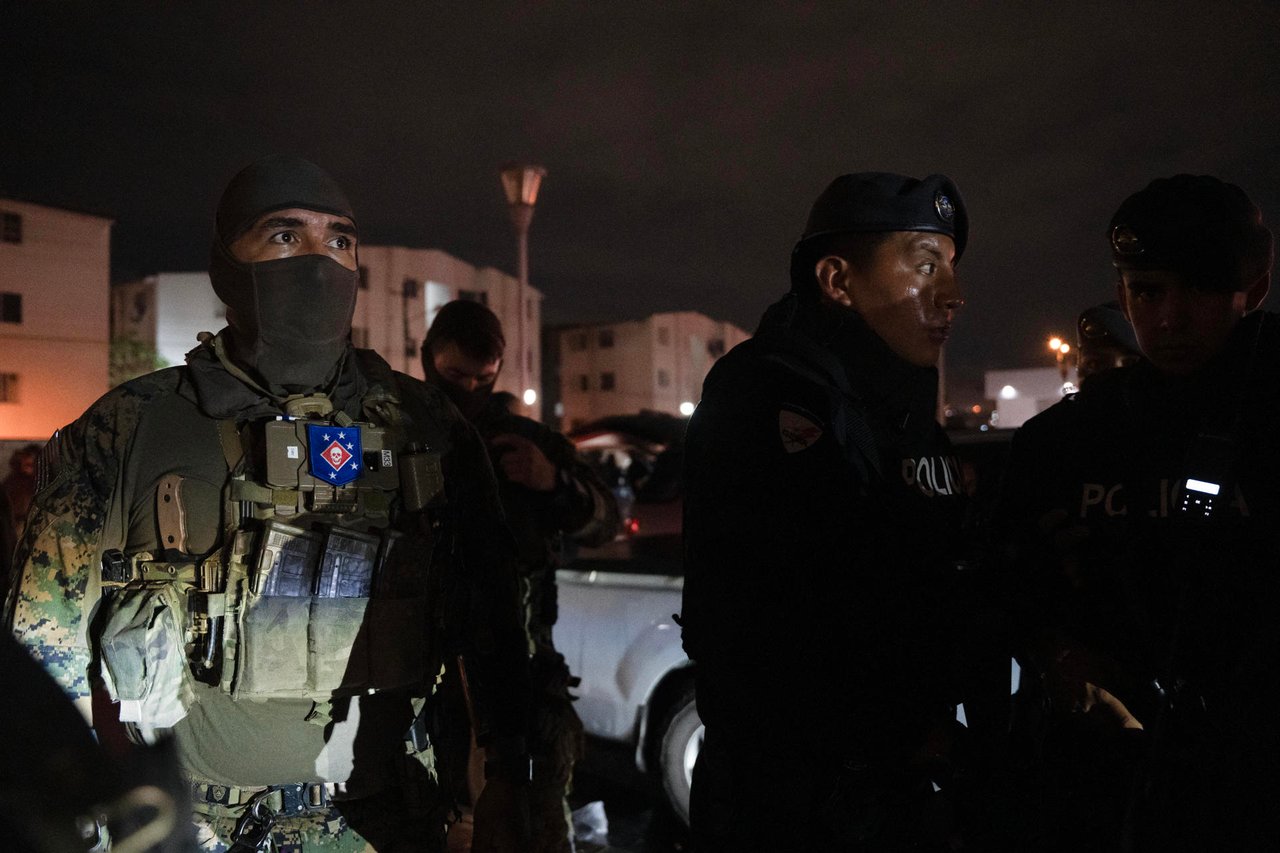
According to their testimonies, armed men wearing military-style uniforms appeared afterward. The fishermen said they were handcuffed, hooded, and detained. Several of the men guarding them spoke English.
Human Rights Watch investigated the three cases and suggested there were indications of US involvement. Primicias also reported on the organization’s conclusions in Ecuador. Primicias
But for months, no one could answer a fundamental question:
Who was attacking these boats?
The New York Times followed the leads.
In August, The New York Times published an in-depth investigation into the Ecuadorian fishermen and the mysterious attacks.
Its journalists reconstructed the incidents using testimonies, images, available data, and other evidence. Survivors described armed men, drones, and personnel speaking English and carrying elements associated with the United States.
But one crucial piece was still missing: identifying who was behind the operation.
A day later, a much more disturbing answer emerged.
The Washington Post: a clandestine CIA program
On August 13, The Washington Post published an investigation linking the mysterious attacks to a covert CIA program authorized as part of the expansion of US operations against transnational criminal organizations. The Washington Post
The newspaper also found a particularly important clue.
Air traffic tracking data showed that a surveillance plane identified as FENIX 701 flew towards the area where the Fiorella was located on January 17, 18, and 20.
On January 20 — the same day contact was lost with the boat — the plane traveled approximately 750 miles towards its location before temporarily disappearing from public tracking systems.
About two and a half hours after the aircraft landed again in El Salvador, the Fiorella transmitted its location for the last time. The Washington Post
This does not prove what happened to the boat or its eight crew members.
But the Post‘s investigation substantially transformed the story.
What initially seemed to depend on the extraordinary testimonies of a group of Ecuadorian fishermen now had additional evidence pointing to a clandestine US operation.
The newspaper also reported that Trump had granted new powers to the CIA to combat drug trafficking, including authorization for covert operations against transnational criminal organizations and the use of lethal force. The Washington Post
The prosecutor who was asking questions
Before The New York Times and The Washington Post published their investigations, Alexandra Bravo was already trying to determine what had happened.
A particularly important source appears here.
Human Rights Watch spoke directly with her.
In May, about a month before her murder, investigators from the organization interviewed Bravo about the Fiorella case.
The prosecutor explained that she had opened an investigation and requested information from different authorities.
Weeks later, she was murdered.
Her death immediately raised an inevitable question: was her murder related to the investigation?
So far, there is no public evidence to confirm this.
Bravo was handling other cases related to homicides, kidnappings, and organized crime in an extremely violent region. Ecuadorian authorities have described her murder within the context of retaliation by criminal structures against prosecutors. Primicias
Human Rights Watch also warns about this context. Bravo was the third prosecutor killed in Manta since 2022. Human Rights Watch
Therefore, it would be irresponsible to claim that the US, the CIA, or someone related to the maritime operations was involved in her murder.
There is no public evidence to prove it.
But that does not eliminate the questions.
What we know — and what we still don’t know
We know that Alexandra Bravo was murdered.
We know that she was investigating at least one of these cases because Human Rights Watch spoke directly with her about the investigation.
We know that Ecuadorian fishermen reported attacks with drones and detentions by armed men who spoke English.
We know that subsequent journalistic investigations found additional evidence related to those attacks.
And we know that The Washington Post ultimately linked them to a clandestine CIA program. The Washington Post
What we don’t know is equally important.
We don’t know what happened to the eight missing crew members of the Fiorella.
We don’t know exactly who made the operational decisions behind each attack.
And there is no public evidence establishing a connection between those operations and Bravo’s murder.
The difference between what is proven, what is likely, and what is unknown is essential in a story like this.
But the US context has also changed.
This story takes on another dimension when analyzed through the lens of the policy that Donald Trump is developing for the Western Hemisphere.
It’s not necessary to interpret his intentions. The President and his administration have expressed them publicly.
In December 2025, Trump formally announced what he called a «Trump Corollary» to the Monroe Doctrine.
The White House said that the US was reaffirming a doctrine that establishes US leadership in the Western Hemisphere.
Trump declared that his government was «restoring US maritime dominance» and stated that «US leadership is coming back stronger than ever.» The White House
Perhaps the most important document is the US National Security Strategy itself.
There, the Trump administration sets out its objectives for the hemisphere, including preventing incursions by hostile powers, securing supply chains, and ensuring the US has continuous access to strategic locations.
Then it explicitly states how it plans to achieve this:
The US will “assert and enforce” a “Trump Corollary” to the Monroe Doctrine. The White House
This is an extraordinarily direct formulation of US policy towards the Americas.
«We are reaffirming US power»
Trump was even more explicit before the United Nations on September 22.
He stated that the US would not allow threats to the country to establish themselves «anywhere in the Western Hemisphere.» He warned that he would use military power when he considered US vital interests to be at risk.
Then he summarized the doctrine:
“We are reaffirming US power, including US military power when necessary, in our region”. The White House
The strategy is not just on paper.
The US has expanded the CIA’s powers against transnational criminal organizations, increased anti-narcotics operations, and carried out attacks on boats it considers linked to drug trafficking. The Washington Post‘s investigation describes the CIA program near Ecuador as a clandestine and separate phase of publicly recognized military operations. The Washington Post
And the shift towards Latin America continues.
This week, the Trump administration decided to redirect $52 million in military aid originally destined for European and Middle Eastern countries to Ecuador, Colombia, Panama, and Peru.
The State Department justified the decision as part of a foreign policy that once again prioritizes the Western Hemisphere and the fight against «narcoterrorism.» The Washington Post
A question that goes beyond Ecuador
From the perspective of the Trump administration, there is a clear logic behind this strategy.
Transnational cartels transport drugs to the US, operate across national borders, and take advantage of weak institutions, corruption, and maritime routes. Washington argues that combating them requires the use of military, intelligence, diplomatic, and economic tools previously reserved for other threats.
But for Latin America, there is another question.
What happens when this fight begins to include military attacks, clandestine intelligence operations, and a presidential doctrine that explicitly states that the US must «assert and enforce» its strategic primacy in the hemisphere?
Nothing known so far proves that the CIA, the US government, or the operations investigated by Alexandra Bravo had any relation to her murder.
This limit between what we know and what we still don’t know is fundamental.
But the sequence cannot be ignored either.
Three Ecuadorian boats were attacked or disappeared. Survivors described drones and armed men speaking English. A prosecutor began to investigate. That prosecutor was murdered. Human Rights Watch confirmed that it had spoken with her about the case a few weeks before her death.
Subsequently, investigations by The New York Times and The Washington Post found new evidence about the attacks, and the Post linked them to a clandestine CIA program.
All this occurs while the President of the United States proclaims a new version of the Monroe Doctrine, his National Security Strategy promises to «assert and enforce» it, and Trump publicly declares that the US is «reaffirming its power» in the hemisphere. The White House
This leaves a question that will likely become increasingly important for Ecuador and the rest of Latin America:
Given this administration’s declared push to reaffirm control, power, and US primacy in the Americas, was what happened off the coast of Ecuador an exceptional episode, or are we seeing the first signs of a much darker trend for the coming years?
For now, eight fishermen remain missing.
And the murder of the prosecutor who tried to find out what happened to them remains unsolved.
Sources used
The Washington Post — August 13, 2026: Covert CIA program said to be behind mysterious attacks on Galápagos boats. This is the central investigation linking the attacks to a covert CIA program and analyzing FENIX 701, survivor testimonies, and the expansion of the agency’s clandestine powers. The Washington Post
The New York Times — August 2026: investigation by Maria Abi-Habib, Riley Mellen, José María León Cabrera, and Christiaan Triebert on the attacks against Ecuadorian fishermen. The Times’ page was not directly accessible during this review, so no exclusive claims from the Times should be used without verification against the original before publication. The New York Times
Human Rights Watch — June 16, 2026: Ecuador: Prosecutor Shot and Killed. Confirms Bravo’s murder, her professional background, and that she was the third prosecutor killed in Manta since 2022. Human Rights Watch
Human Rights Watch — July 2026: investigation into the security cooperation between the US and Ecuador and the attacks on Fiorella, Negra Francisca Duarte II, and Don Maca. Ecuadorian media also reported its conclusions. Primicias
The White House — December 2, 2025: Presidential Message on the Anniversary of the Monroe Doctrine. Primary source for the «Trump Corollary», the reaffirmation of US leadership in the hemisphere, and «US maritime dominance». The White House
The White House — National Security Strategy 2025: a particularly important primary source. Defines US interests in the hemisphere and states that Washington will «assert and enforce» the Trump Corollary to the Monroe Doctrine. The White House
The White House — Trump’s speech before the United Nations, September 22, 2026: primary source for Trump’s statement on «reaffirming US power,» including military power, in the hemisphere. The White House
The Washington Post — October 1, 2026: report on the decision to redirect $52 million in military aid to Ecuador, Colombia, Panama, and Peru, and the State Department’s justification for prioritizing the Western Hemisphere again. The Washington Post
Primicias — June 14, 2026: Who was Alexandra Bravo, the prosecutor murdered in Manta. Documents her murder, professional career, and cases she was handling. Primicias
Primicias — June 14, 2026: What is known about the murder of prosecutor Alexandra Bravo in Manta. Covers the initial investigation and the position of the Ecuadorian Prosecution. Primicias
Primicias — July 21, 2026: Ecuadorian coverage of Human Rights Watch’s conclusions on possible US involvement in the attacks on the three boats. Primicias
El Universo — June 14, 2026: contemporary coverage of Alexandra Bravo’s murder and her sister’s in Manta. El Universo
El Universo — June 14, 2026: coverage of the Ecuadorian Prosecution’s statement, which described the crime as a retaliation linked to the institution’s fight against criminal structures. This represents the Prosecution’s position, not a judicial conclusion about the motive.